 214-904-9400


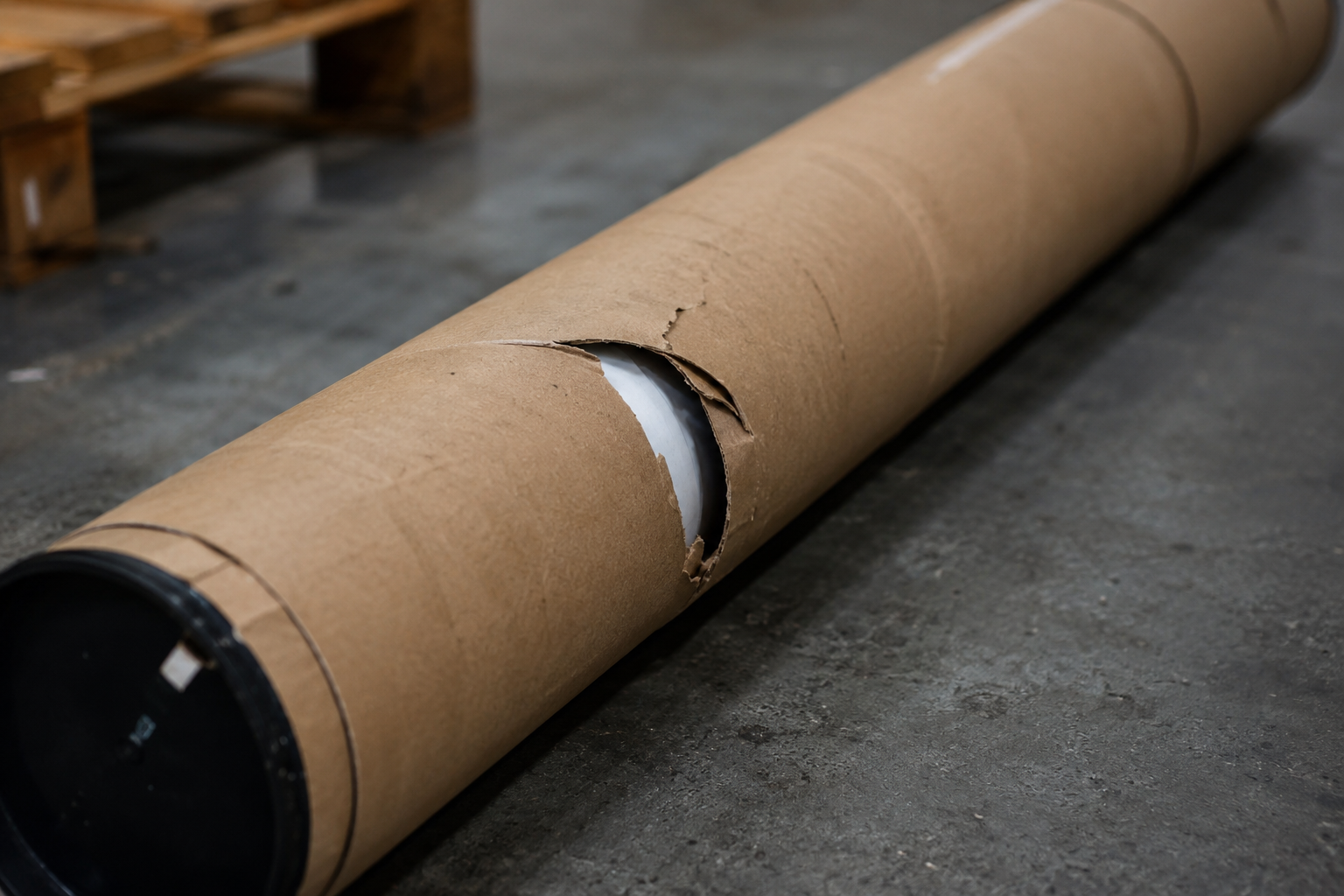
Packaging costs money. Tubes, end caps, foam padding, moisture barriers, custom crating for flat rigid prints – none of it is free, and none of it shows up in the finished product. For a printer competing on price, it’s an easy line item to minimize. They’ll wrap your $2,000 trade show backdrop in a single layer of craft paper and call it done.
The problem is that when something arrives damaged, the cost doesn’t fall on the printer – it falls on you. Your event setup gets delayed. Your client sees the damage before they see the graphic. A reprint, if there’s even time for one, costs more than all the packaging they saved combined. The printer already got paid.
This is a structural misalignment in how cheap printing works. The printer’s incentive is to minimize the cost per job. Your incentive is for the print to survive and arrive installation-ready. Those two things are not automatically the same.
The Four Ways Large Format Prints Get Destroyed in Transit
Before we talk solutions, let’s name the culprits. There are four primary failure points between a print leaving production and arriving intact on-site.
Improper rolling and core selection. Large format prints rolled too tightly – or on a core with the wrong diameter – develop a set curl that never fully relaxes. Rolled in the wrong direction, the ink layer cracks on the vinyl. Rolled without a protective interleaf, the surface abrades against itself.
Insufficient tube and end-cap protection. A rolled print inside a cardboard tube with no end caps is a lottery ticket. Carriers drop packages. Forklifts clip corners. One impact of the end of an unprotected tube is that it collapses and creases the print inside beyond repair.
Humidity and temperature exposure. Fabric prints absorb moisture. Vinyl expands and contracts. A pallet that sits on a loading dock in summer heat or in a cold freight container for three days can arrive warped, bubbled, or with color shifts you didn’t create. The right barrier packaging prevents this. Most printers skip it.
Carrier handling – the variable you can’t control but can prepare for. Packages get dropped, stacked under heavy freight, and conveyed through systems that treat every box the same, regardless of what’s inside. You cannot control the carrier. You can control how well your print is protected when they inevitably treat it like a box of auto parts.
Why Most Printers Cut Corners Here
Packaging costs money. Tubes, end caps, foam padding, moisture barriers, custom crating for flat rigid prints – none of it is free, and none of it shows up in the finished product. For a printer competing on price, it’s an easy line item to minimize. They’ll wrap your $2,000 trade show backdrop in a single layer of craft paper and call it done.
The problem is that when something arrives damaged, the cost doesn’t fall on the printer – it falls on you. Your event setup gets delayed. Your client sees the damage before they see the graphic. A reprint, if there’s even time for one, costs more than all the packaging they saved combined. The printer already got paid.
This is a structural misalignment in how cheap printing works. The printer’s incentive is to minimize the cost per job. Your incentive is for the print to survive and arrive installation-ready. Those two things are not automatically the same.
What Proper Packaging Actually Looks Like
There’s no single universal standard – good packaging is project-specific. A dye sublimation fabric display ships differently than a rigid foam board graphic, which ships differently than a vinyl floor wrap. What they all share is intention. Someone looked at the print, thought about what could go wrong in transit, and built protection around that risk.
For rolled prints, that means the right core diameter for the material, interleaf paper between layers, foam end protection, rigid outer tube, and sealed end caps. For flat rigid prints, it means foam padding on all six faces, double-wall corrugated, and clearly marked orientation so freight handlers don’t stack 200 pounds on the face.
For trade show graphics heading to a convention center – where union crews unload freight fast and dock areas are chaotic – it means packaging that can take a hit and still deliver a perfect graphic on the other side. It also means clear labeling, organized packing lists, and packaging that’s designed to be opened and repacked on-site without a forklift.
The XL Digital Approach: Packaging Is Part of the Product
At XL Digital, we treat packaging as part of the deliverable – not an administrative task at the end of production. After more than 24 years of shipping large-format graphics to trade shows, sports venues, retail rollouts, and events across the country, we’ve learned exactly where prints get damaged and built our packaging protocols around eliminating those failure points.
Our team selects the appropriate core, determines the correct roll direction for each substrate, applies interleaf where needed, and packages for the specific destination – because a graphic going to a controlled corporate lobby needs different protection than one headed to an outdoor festival. We don’t have a single default box. We match the packaging to the project.
We’ve also seen what happens when this breaks down – which is exactly why we’re this disciplined about it. When a client calls us at midnight because their backdrop arrived creased and their event opens in 14 hours, the conversation is always the same: who printed it, and how did it ship? The answer is rarely one of our jobs. But we’ve reprinted plenty of other printers’ damaged work on rush timelines, which means we understand the cost of this problem better than almost anyone.
The Question to Ask Every Printer Before You Place an Order
Before your next large-format project ships, ask your printer one question: “Walk me through how this will be packaged.” If they can’t answer specifically – tube diameter, interleaf material, end protection, outer packaging for the destination environment – that’s your answer.
The print you ordered deserves to arrive the way it left production. At XL Digital, that’s not an assumption – it’s a standard. Reach out to our team at xldigital.com or call 214-904-9400 to talk about your next project and what it takes to get it there in perfect condition.