 214-904-9400


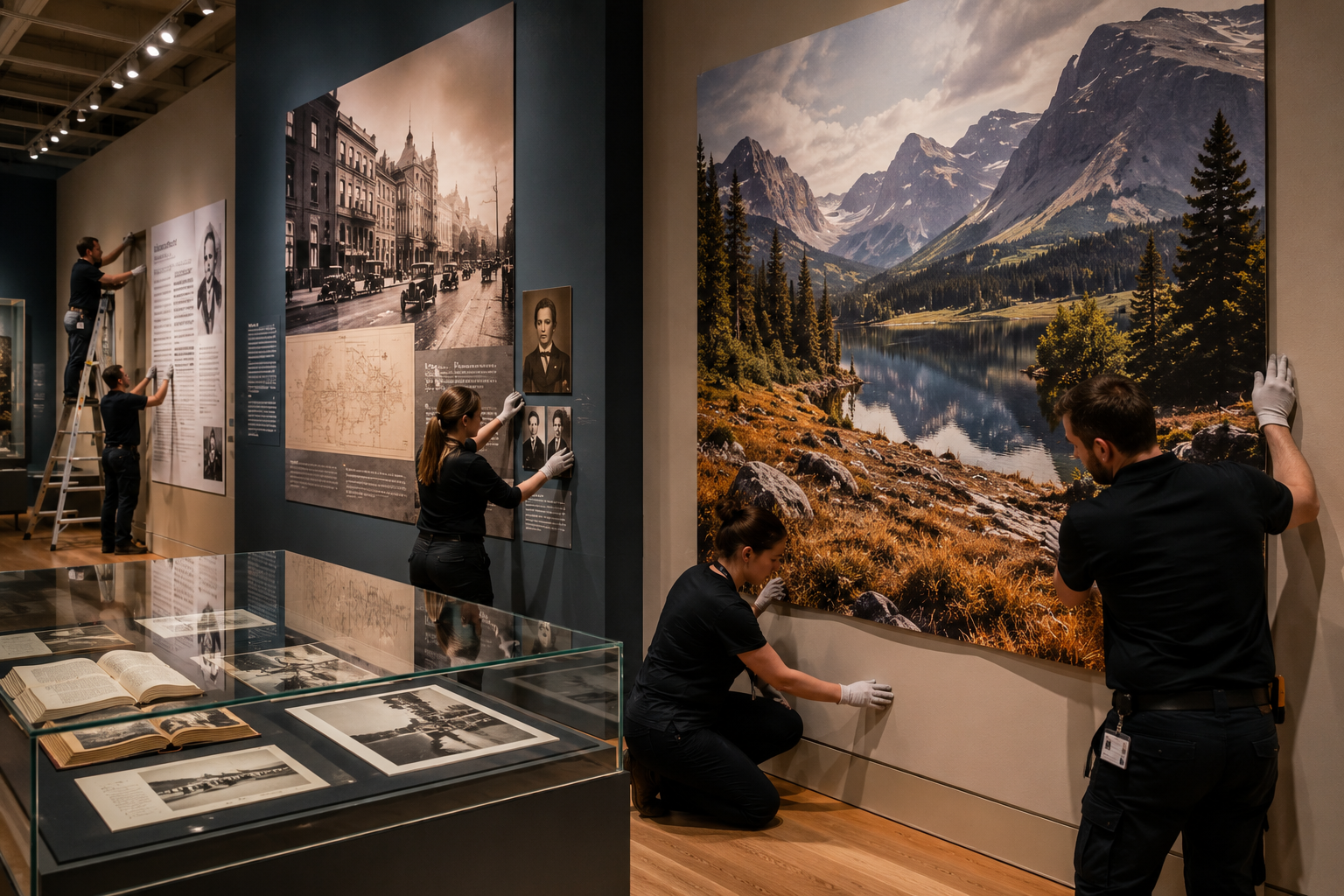
A trade show graphic that is slightly off in color will be seen by thousands of people for three days and then rolled up and stored. A museum exhibition graphic might hang in a permanent gallery for a decade, viewed by millions of visitors under carefully controlled lighting, next to original artworks or artifacts whose visual integrity the institution has staked its reputation on protecting. The stakes are categorically different. So is the production process required to meet them.
The Color Accuracy Problem
Color accuracy in museum graphics is not about getting close. When a natural history museum installs large-format graphics depicting specific species, the colors in the print need to match the scientific record. When an art museum creates reproduction graphics for an educational gallery, the colors must faithfully represent works whose original pigments have been cataloged and documented to a very high degree of precision. When a history museum produces interpretive graphics that include archival photographs, the tonal rendering of those images carries meaning that casual approximation destroys.
Achieving this level of accuracy requires more than a well-calibrated printer. It requires a complete and managed color workflow from source file to output, including ICC profiles matched specifically to the substrate being used, spectrophotometer-verified output, and a printer experienced enough to know when something looks technically correct but visually wrong. These are not common capabilities. Most print shops optimize for speed and volume. Museum-grade color accuracy requires a different kind of discipline.
Archival Materials and Longevity
The second major distinction in museum graphics is material selection for longevity. Consumer and commercial print environments think about durability in terms of months. Museums think in years and decades.
Archival-quality large format printing requires inks that resist UV-induced fading, substrates that will not yellow, crack, or delaminate over time, and mounting and finishing approaches that do not introduce acids or off-gassing that could affect nearby artifacts or degrade the print itself. The wrong laminate applied over the right print can ruin the investment within a few years. The right combination, chosen correctly from the start, can maintain integrity for the life of an exhibition.
Material selection for permanent or semi-permanent museum installations also needs to account for the environment. Climate-controlled galleries create specific conditions that affect how substrates behave over time. Humidity fluctuations that would be inconsequential in a retail setting can cause rigid substrates to warp or fabric graphics to shift dimensionally in museum environments where fractions of an inch matter. Getting material selection right requires both product knowledge and experience with how those products perform in institutional settings.
Zero Tolerance for Errors
In commercial large-format printing, errors are costly but manageable. A damaged trade show graphic can be reprinted. A retail installation with a color variance can be noted and corrected on the next run. Museums operate differently. Exhibition opening dates are public, immovable, and tied to institutional events, press coverage, and donor commitments. An error discovered during installation is not a revision request. It is a crisis.
This is why the prepress and quality control process for museum graphics demands a different standard. Files need to be reviewed not just for technical correctness but for content accuracy, because a mislabeled species, an incorrectly dated photograph, or a misquoted text panel in a museum graphic is a factual error that the institution will be held accountable for. Color proofing needs to happen on the actual substrate being used for production, not a reference proof on a different material. Print output needs to be verified against the proof before anything is approved for final production.
The production workflow that supports this level of quality control looks different from standard commercial printing. It is more methodical, involves more checkpoints, and requires a print partner that treats the approval process as seriously as the client does.
Scale Without Compromise
Museum graphics are often large. Interpretive murals, environmental graphics that span entire gallery walls, floor-to-ceiling photographic reproductions, and multi-panel installations that need to read as seamless. At this scale, every technical variable compounds. A small color inconsistency across a panel seam becomes visible at gallery viewing distances. A slight tension variation in a fabric installation creates visible banding. A resolution that looks acceptable in a proof looks soft when printed across 20 feet of wall.
Managing quality at this scale requires both the equipment capacity to produce large-format output without seams that degrade appearance and the technical discipline to maintain consistency across an entire run. Not every large-format printer can hold color consistency across a multi-panel installation where all panels must match each other as closely as they match the proof. This is a genuine differentiator between production facilities, and museums have learned to ask hard questions about it before placing orders.
Why This Work Fits XL Digital
Museum and gallery graphics represent exactly the type of work that separates print partners who can handle complexity from those who cannot. The combination of color accuracy demands, archival material requirements, zero-error tolerance, and large-scale production without quality compromise requires a production facility with the right equipment, the right processes, and experienced people who understand what is at stake.
XL Digital has spent more than 24 years building the kind of operation that performs under exactly these conditions. Our color management systems, maintained and calibrated to produce accurate and repeatable output, are the same systems that serve clients whose brand standards allow no variance across hundreds of locations. Our prepress team brings the same discipline to museum file review that they bring to complex multi-venue retail rollouts, where errors have real consequences. Our material expertise covers the full range of archival-quality substrates appropriate for institutional environments.
What museums need from a large-format printer is the same thing our most demanding commercial clients need: a partner who takes the quality standard as seriously as they do, and has the production capability to actually meet it. That is what we do.
If your institution has an upcoming exhibition, permanent gallery installation, or interpretive graphics project, we would welcome the conversation. Reach out at xldigital.com or call 214-904-9400 to talk through what your project requires.