 214-904-9400


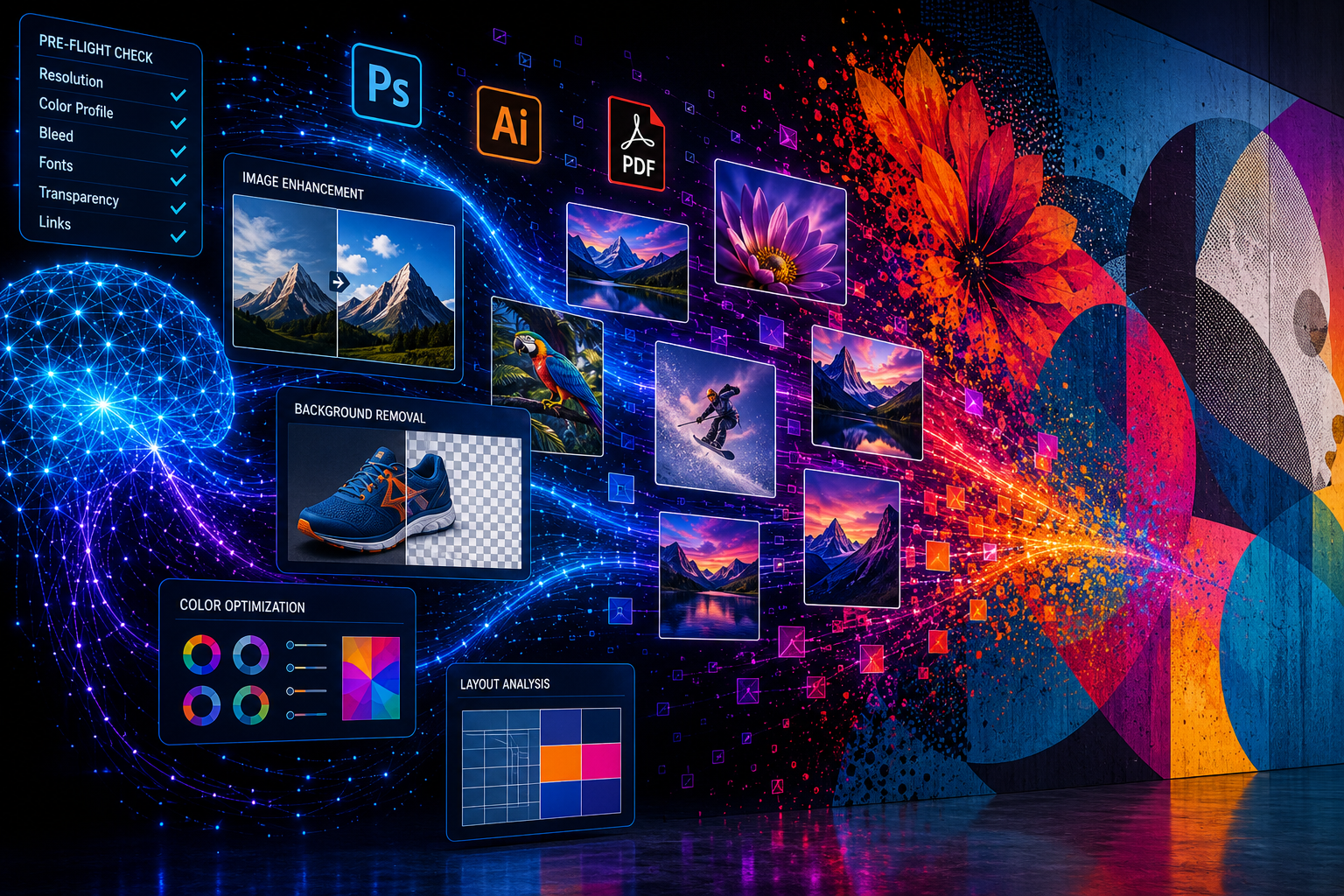
If you work with a large-format printer regularly, you already know that bad file prep is one of the most common reasons projects get delayed. Low-resolution images, wrong color profiles, missing bleeds, fonts that weren’t outlined, layers left ungrouped. The list is long, and the errors are predictable. Which is exactly why AI is starting to make a real difference here.
Artificial intelligence is not replacing the skilled prepress technicians who catch the things machines miss. But it is automating a significant portion of the repetitive, rules-based work that slows down production and creates friction between designers, agencies, and print shops. For anyone ordering large-format graphics, that shift matters.
What Prepress Actually Involves
Before a file touches a printer, it goes through a prepress process that checks for and corrects a range of technical issues. Color mode needs to be right for the output device. Resolution needs to be appropriate for the substrate and viewing distance. Bleeds need to be set correctly so nothing gets cut short. Fonts need to be embedded or outlined. Image links need to be intact. Color profiles need to match.
For a small project, this might take a few minutes. For a complex multi-panel trade show display with a dozen layered files from three different designers, it can take hours. Errors found late in this process mean revision rounds that burn time nobody has. For a print provider like XL Digital working on event and trade show timelines where deadlines are fixed and non-negotiable, prepress efficiency is not a nice-to-have. It directly determines whether a client’s graphics make it to the show floor on time.
Where AI Is Making an Impact Right Now
AI tools have gotten genuinely useful in several specific areas of file prep and prepress. These are not theoretical capabilities being promised in future software releases. These are things happening in production workflows today.
Automated preflight checking. Software can now scan incoming files and flag issues in seconds rather than minutes. Color space mismatches, insufficient resolution for the output size, missing fonts, incorrect bleed settings, and embedded transparency issues. AI-powered preflight tools are faster and more consistent than manual review, and they don’t get fatigued on the 40th file of the day.
Image upscaling and resolution enhancement. This is one of the most practically useful AI applications in large-format prep. Tools like Adobe Firefly, Topaz Gigapixel, and similar products can upscale low-resolution images with significantly better results than traditional bicubic interpolation. A client submits a logo at 72 dpi when 150 dpi is needed. AI upscaling can close a gap that previously meant going back to the client for a better file or reprinting with visible quality loss.
Background removal and masking. Cutting out complex objects from backgrounds used to require skilled retouching hours. AI tools now accomplish in seconds what once took significant manual effort, and the results are often indistinguishable from hand-masking for most large-format applications.
Color correction and profile matching. AI is beginning to assist with color adjustments that account for substrate behavior, helping anticipate how a specific ink and material combination will shift color values at output. This is still maturing, but early applications are helping reduce the number of test prints needed to dial in accurate color on unfamiliar substrates.
Layout anomaly detection. AI can now scan files for visual inconsistencies that preflight tools miss entirely: text that’s oddly close to a trim line, image panels that don’t align across seams, or brand colors that drift between files in a multi-panel project. These are the kinds of errors that slip through technical checks but show up glaringly in the finished product.
What AI Still Cannot Do
It is worth being clear-eyed about the limits. AI tools are excellent at pattern recognition and rules-based checking. They are not good at judgment calls that require understanding context, intent, or how a specific client would react to a specific outcome.
A prepress technician looking at a file knows when a color that passes technical checks will still look wrong on the material being used. They know when a resolution that is technically sufficient will look soft at the viewing distance of a particular installation. They know when a client’s brand standards mean that an auto-corrected color profile will produce results the client will reject. That kind of contextual knowledge, built from experience across hundreds of different projects and substrates, is not something AI replicates today.
The best production environments are using AI to handle the repetitive and rules-based work so experienced technicians can focus their attention on the decisions that actually require judgment. That combination produces better outcomes than either approach alone.
What This Means for Designers and Agencies
If you’re a designer or creative director submitting files to a large-format printer, AI-assisted prepress has a direct benefit for you: fewer revision rounds and faster turnaround. When a printer can identify and, in some cases, automatically correct common file issues without sending files back, projects move faster. That is especially valuable when you are working against an event deadline.
It also raises the bar for what you can send. AI upscaling means a file that previously could not be used at a large scale now has a path to viability. Background masking tools mean cleaner composites with less manual prep time on your end. These are real-time savings across a project.
That said, AI prepress is not a substitute for sending well-prepared files. A printer working on a tight timeline is going to prioritize the client whose files are clean and ready over the one whose files require significant rework, even if automated tools can handle some of it. Good file prep still gives you a meaningful advantage in how your project is handled.
How XL Digital Approaches File Pre
At XL Digital, prepress has always been treated as a critical production phase rather than an administrative step. With more than 24 years of large-format experience, our prepress team has seen every file problem that exists and built processes to catch them before they cost a client time or money.
We are actively integrating AI-assisted tools where they make our process faster and more reliable, while keeping experienced technicians in the loop on anything that requires judgment. The goal is the same as it has always been: your files go to print the first time correctly, on schedule, and looking exactly the way you intended.
If you have questions about how to prepare files for your next large-format project or want to discuss a project that has complex prepress requirements, our team is ready to help. Reach out at xldigital.com or call 214-904-9400.