 214-904-9400


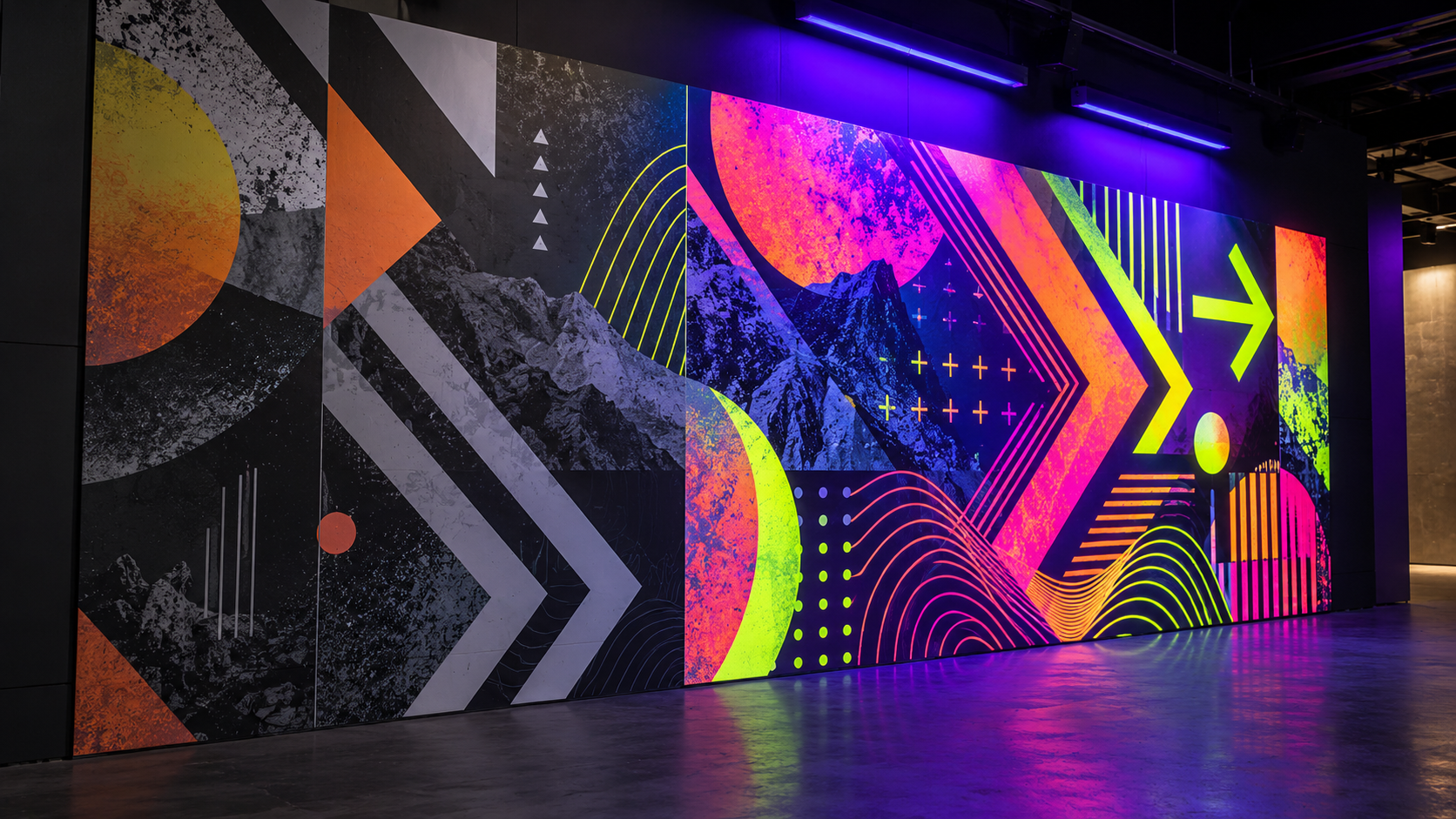
Most people’s only mental reference for fluorescent ink is Halloween, a glowing skeleton on a haunted house wall, maybe a blacklight mini-golf course from a birthday party years ago. That’s a real use case, and a good one, but it’s a small slice of what this ink actually does. We run fluorescent ink year-round for a much wider range of clients than most people expect, and understanding how it actually works explains why it shows up in so many unrelated industries.
The Actual Mechanism, in Plain Terms
Standard CMYK ink doesn’t glow under a blacklight. It absorbs most of the ultraviolet light hitting it and reflects back very little, which is why a normal printed banner looks dull and flat under UV light no matter how bright the colors looked under regular lighting.
Fluorescent ink works on a different principle entirely. It absorbs ultraviolet light and re-emits it at a visible wavelength, which is the actual physical process behind anything that appears to glow under a blacklight. That reaction is what makes a UV-reactive print pop dramatically in a dark room while looking like a slightly unusual, somewhat muted color under normal lighting, since the ink is formulated to perform under UV exposure, not to match a Pantone swatch in daylight.
That tradeoff matters for anyone considering it: you’re not choosing fluorescent ink for how it looks under your office lights, you’re choosing it for how it performs in one specific lighting condition. Everywhere that condition shows up, blacklight, UV party lighting, certain stage and event lighting rigs, this ink has a job to do.
Where It Actually Gets Used
Haunted houses and Halloween attractions are the most seasonal and most visible application, and a genuinely good one, glowing murals, UV-reactive directional signage for mazes, dripping neon effects that only appear once a blacklight hits them. But the client list for this ink stretches well past October.
Nightlife and entertainment venues use it constantly, year-round. Bars, nightclubs, and lounges that run blacklight or UV-accented lighting commission wall graphics, logos, and decor pieces in fluorescent ink specifically so the branding becomes part of the atmosphere once the lights go down, rather than disappearing into the dark like a normal printed sign would.
Music festivals and live events lean on it heavily too, stage backdrops, directional signage for night sections of a festival grounds, and branded elements that are designed to read clearly after dark under the kind of lighting rigs those events already run. A festival sponsor wall printed in standard ink is wasted real estate once the sun goes down; the same wall in fluorescent ink keeps working all night.
Escape rooms and immersive experiences use it for exactly the same reason haunted houses do: controlling what’s visible and when. A clue or a visual effect that’s only meant to appear under a specific light cue is a design tool, not a gimmick, once you’re building a space meant to be experienced in stages.
Retail and pop-up experiences have picked it up more recently, particularly for brands targeting younger, nightlife-adjacent audiences, think streetwear launches, music merchandise pop-ups, or in-store activations built around a UV lighting moment for social media content. A glowing window display or in-store graphic photographs well and does something a standard print simply can’t.
Sports and fan events use it for specific moments too, blackout-themed games, arena entrance tunnels lit for a dramatic team introduction, or fan zone activations built around UV elements as part of the overall event design.
Quick Reference: Where Fluorescent Ink Shows Up
|
Industry / Setting |
Typical Application |
|
Haunted Houses & Halloween |
Scene murals, UV directional signage, scare effects |
|
Nightlife & Venues |
Wall graphics, logos, and decor under blacklight lighting |
|
Festivals & Live Events |
Stage backdrops, night-section wayfinding, sponsor walls |
|
Escape Rooms |
Hidden clues and effects revealed under a UV light cue |
|
Retail & Pop-Ups |
Window displays and in-store UV activations for social content |
|
Sports & Arenas |
Blackout-game graphics, entrance tunnel effects, fan zones |
Fluorescent Ink and Glow-in-the-Dark Paint Are Not the Same Thing
This mix-up comes up constantly, across almost every one of the industries above, so it’s worth untangling clearly. Fluorescent, UV-reactive ink needs an active blacklight source pointed at it to glow. Turn off the UV light and the ink goes back to looking like a slightly unusual, somewhat muted color, nothing more. Glow-in-the-dark (phosphorescent) paint and film work completely differently: they absorb ambient light over time and slowly release it, glowing faintly even after the lights go out entirely, with no UV source required.
A client planning a nightclub wall or a festival backdrop that’s supposed to stay invisible until a blacklight cue hits it needs fluorescent ink. A client wanting a hallway or ceiling element that glows faintly on its own after the lights cut completely needs phosphorescent material instead. Mixing the two up at the planning stage is one of the most common and most avoidable mistakes across every industry that uses UV effects, not just haunted attractions.
Material Considerations Change Depending on the Setting
A haunted house wall deals with fog residue, humidity, and physical contact from actors and guests. A nightclub graphic deals with cigarette and vape residue, spilled drinks, and years of continuous indoor use rather than a single seasonal run. A festival backdrop has to survive outdoor weather, wind load if it’s mounted large, and the wear of a multi-day event. The ink is the same underlying technology in each case, but the substrate and lamination get chosen around the specific environment the piece has to survive, exactly the way material decisions get made for any other print project.
What Fluorescent Ink Can’t Do
It’s worth being direct about the limitations too, since this isn’t a drop-in replacement for standard ink. Fluorescent ink has a more limited color range than full CMYK process printing, it’s built around a handful of UV-responsive pigments rather than the full spectrum, so extremely precise brand color matching isn’t always achievable the way it would be with standard ink. It also tends to cost more per print run, since the ink itself is a specialty product rather than standard stock, and some printers aren’t set up to run it at all, since it requires its own ink channel and a press configured for it.
None of that makes it a bad choice, it just means it’s a tool for a specific job, not a universal upgrade. The right question isn’t whether fluorescent ink is better than standard ink, it’s whether the piece is actually going to live under UV or blacklight conditions where the effect matters. If the answer is yes, it’s one of the more striking things we print all year. If the answer is no, standard ink will do the job better and for less.
A Quick Checklist for Planning a Fluorescent Ink Project
- Confirm you actually need UV-reactive ink and not phosphorescent (glow-in-the-dark) material, they solve different problems
- Expect colors to look slightly different under normal light than they will under blacklight, and proof accordingly
- Match the substrate and lamination to the environment: indoor permanent install, seasonal outdoor run, or single-event use
- Plan lighting alongside the print, UV-reactive ink is only as effective as the blacklight source pointed at it
- Order with enough lead time if your project falls in a high-demand season like the weeks before Halloween
Why We Like Printing This Stuff
Most of what we print is built to communicate clearly under normal conditions, a clean banner, a readable sign, a brand wall that does its job without drawing attention to the ink itself. Fluorescent printing flips that. It only works under a specific condition, and getting it right means thinking about light, timing, and atmosphere in a way standard print work rarely asks for.
Whether you’re planning a haunted house, a nightclub renovation, a festival activation, or a retail pop-up that needs to glow under the right lighting, reach out to XL Digital. We keep fluorescent ink in regular production, not just as a seasonal add-on, which means we can talk through the actual application with you instead of treating it like a once-a-year novelty.